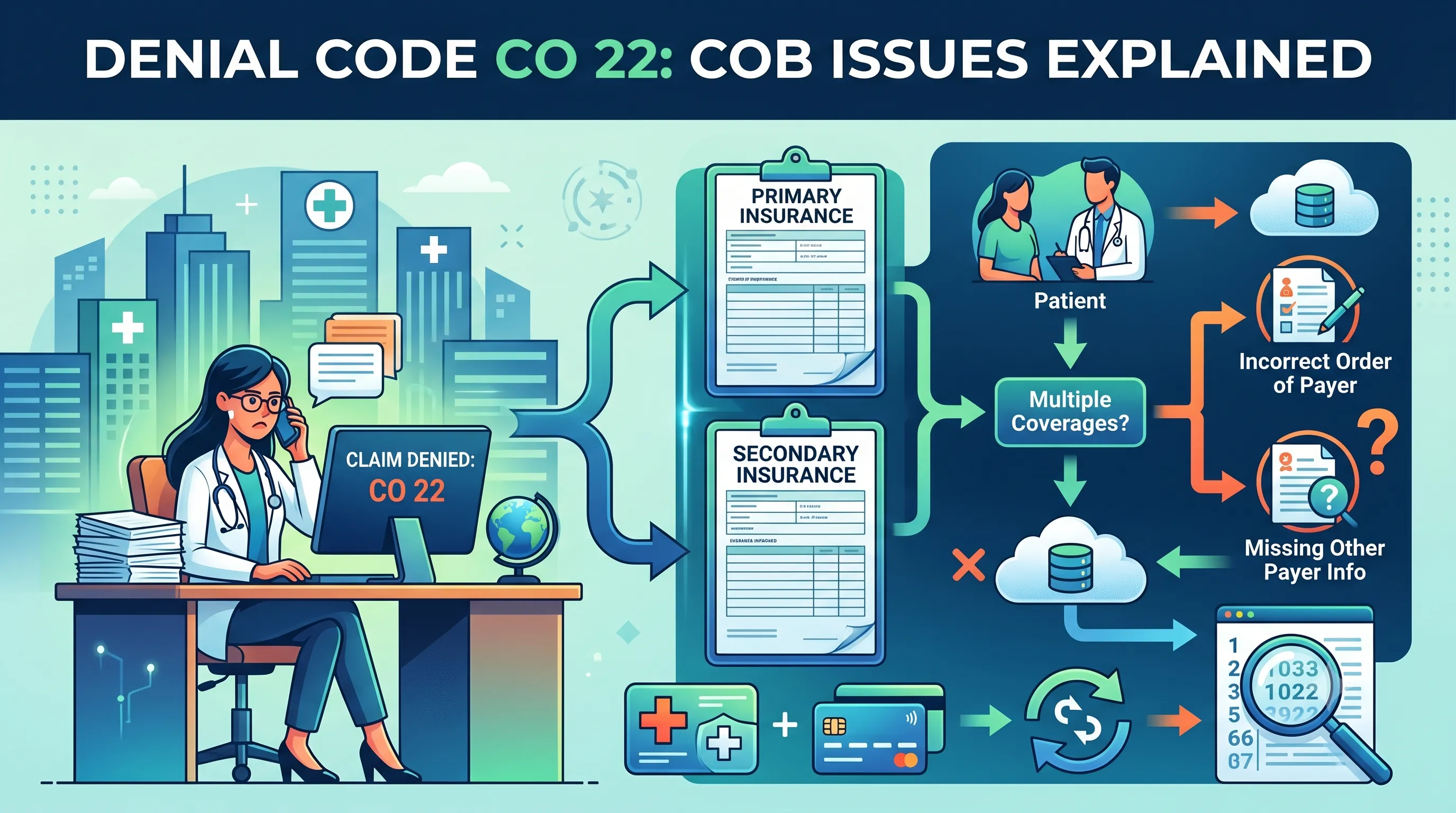
Every time a CO 22 denial lands in your AR queue, it signals one thing to your revenue cycle: a clean claim was adjudicated by the wrong payer, in the wrong order, or with missing coordination data — and no money is coming until it is fixed. For practices that routinely treat patients with dual coverage, CO 22 is not a rare edge case. It is a systemic workflow failure point that compounds daily. Left unmanaged, CO 22 denials inflate your Days in AR, inflate your cost-to-collect per claim, and silently erode net collection rates across commercial, Medicare Advantage, and Medicaid payer lines.
This article is a complete operational reference for medical billers, RCM managers, and practice administrators who need to understand, prevent, and resolve CO 22 denials with precision — including payer-specific nuances for UnitedHealthcare, Aetna, Cigna, Humana, and BCBS plans.
What Does Denial Code CO 22 Mean?
CO 22 is a Claim Adjustment Reason Code (CARC) defined by the Washington Publishing Company (WPC) under the ANSI X12 835 transaction standard. The exact definition is:
"This care may be covered by another payer per coordination of benefits."
The "CO" prefix designates a Contractual Obligation adjustment — meaning the payer is asserting that the denial or adjustment is based on a contractual or regulatory rule, and the patient cannot be billed for the denied amount. The liability for resolution lies entirely with the provider's billing team.
CO 22 is not a patient eligibility denial. It is a sequencing and data sufficiency denial. The payer is not saying the service is non-covered; it is saying: "We believe another payer should process this claim first, or you have not given us sufficient COB data to process it in the correct order."
The COB Framework: Why Payers Issue CO 22
How Coordination of Benefits Works Legally
Coordination of Benefits rules are governed by a patchwork of federal and state regulations:
NAIC Model COB Regulation — adopted by most states, establishes the "birthday rule" for dependent child coverage and primary/secondary sequencing logic.
Medicare Secondary Payer (MSP) Act — 42 U.S.C. § 1395y(b) — governs situations where Medicare should pay secondary to a commercial plan, employer group health plan (EGHP), or no-fault/liability insurer.
Medicaid Always-Last Rule — by statute, Medicaid is the payer of last resort in all COB situations.
When a patient has dual coverage, every payer in the chain needs to know:
Who is the primary payer?
What did the primary payer pay or deny, and why?
What patient liability (deductible, coinsurance, copay) remains?
When your claim lacks this data — or presents it incorrectly — the receiving payer issues CO 22.
Common Triggers for CO 22 Denials
Understanding what triggers CO 22 at the payer's adjudication engine allows you to attack the root cause rather than chasing individual denials:
Trigger | Explanation |
|---|---|
Claim submitted to secondary without primary EOB data | Secondary payer cannot calculate their liability without knowing what primary paid |
Incorrect payer sequencing on CMS-1500 or 837P | Fields 11, 11a–11c, and 9a–9d not populated correctly; primary/secondary payer order wrong |
Primary payer information changed but not updated in practice management (PM) system | Stale eligibility data causes claim to route to wrong payer as primary |
Patient enrolled in Medicare but EGHP is still primary (MSP situation) | Billing Medicare first when employer group health plan should pay primary triggers MSP-related CO 22 |
COB data loop (Loop 2320 in 837P) missing or incomplete | Clearinghouse strips or does not map OI (Other Insurance) segment correctly |
Worker's compensation or auto liability carrier is primary | Practice bills health insurance before exhausting WC/auto coverage |
Medicaid billed before commercial carrier adjudicates | Medicaid always secondary to any other coverage |
Reading a CO 22 Denial: The 835 Transaction and the Remittance Advice
When a CO 22 denial comes back on an Electronic Remittance Advice (ERA) via the ANSI X12 835 transaction, you will typically see it structured in the CLP/CAS segment loop:
CLP*[claim number]*4*[billed amount]*0*0*[payer claim control number]
CAS*CO*22*[billed amount]
The CLP status code "4" = Denied. The CAS segment with CO*22 = Contractual Obligation, reason code 22.
What to look for immediately on the 835:
Claim Adjustment Group Code (CAGC): Confirms "CO" — non-billable to patient
RARC (Remittance Advice Remark Code): Often paired with CO 22 to add specificity. Common RARCs alongside CO 22 include:
MA04 — "Secondary payment cannot be considered without the identity of or payment information from the primary payer."
N89 — "Not covered when performed during the same session/date as a previously processed service."
OA23 — (if OA group) — indicates Medicare paid as primary and secondary payer rules apply.
The RARC is your operational signal for exactly what data is missing. MA04, for example, tells you the secondary payer received the claim without primary EOB data attached — an entirely fixable data problem.
The Five Primary CO 22 Scenarios and How to Fix Each One
Scenario 1: Secondary Claim Submitted Without Primary EOB/EOB Data
What happened: Your billing team submitted the claim to the secondary payer (e.g., a BCBS supplemental plan, Medicaid, or a Medicare Advantage secondary) before receiving — or without transmitting — the primary payer's Explanation of Benefits (EOB) and payment data.
How to fix it:
Pull the primary payer's ERA/EOB for the DOS in question.
Resubmit the corrected claim to the secondary payer, populating:
CMS-1500 Box 11: Primary payer name, policy number
CMS-1500 Box 11a: Insured's date of birth and sex (primary)
CMS-1500 Box 11b: Employer name (if applicable)
CMS-1500 Box 11c: Insurance plan name / program name
CMS-1500 Box 11d: Check "YES" for another health benefit plan
CMS-1500 Box 29: Amount paid by primary
CMS-1500 Box 28 (Total Charges) vs Box 29: The difference informs the secondary of remaining patient liability
In the 837P electronic claim, ensure Loop 2320 (Other Subscriber Information) and Loop 2330A/2330B (Other Payer Name and Subscriber) are fully populated, including:
OI segment: COB payer sequence code, benefits assignment certification indicator
AMT segment: COB payer-paid amount (qualifier "D" for payer paid)
CLP/SBR segment in 835: Primary payer's claim processing information
Payer-specific note: When billing Medicaid as secondary after a commercial primary (UHC, Aetna, Cigna), most state Medicaid programs require the primary payer's ICN (Internal Control Number) or claim number transmitted in Loop 2330B REF*F8 (Other Payer Prior Authorization Number). Missing this will regenerate CO 22 on resubmission.
Scenario 2: Medicare Secondary Payer (MSP) Violations
This is the highest-stakes CO 22 variant. When Medicare should be secondary but you billed it primary — or vice versa — the financial exposure includes potential Medicare Secondary Payer compliance liability in addition to the denied claim.
MSP Primary Payer Situations (Medicare should be SECONDARY):
MSP Situation | Primary Payer |
|---|---|
Working aged (65+) with employer group health plan (EGHP) — employer has 20+ employees | EGHP |
End-Stage Renal Disease (ESRD) — first 30 months after eligibility | Commercial/EGHP |
Disability — employer with 100+ employees | EGHP |
Workers' Compensation — work-related illness/injury | WC carrier |
Auto/No-Fault/Liability — accident-related care | Auto/Liability insurer |
Veterans Affairs — service-connected care (in most circumstances) | VA |
How to fix MSP-related CO 22:
Query the CMS COBSW (Coordination of Benefits Secure Website) or use the HIQA (Health Insurance Query for Acute Care) tool to verify Medicare's actual secondary status for the patient.
If Medicare should have been secondary:
Bill the correct primary payer first
Upon primary adjudication, resubmit to Medicare with the primary EOB data in Loop 2320 of the 837I or 837P
On the CMS-1500, complete Box 11 through 11d with primary payer data and enter the primary's paid amount in Box 29
If Medicare was correctly primary and the CO 22 was issued in error by a Medicare Advantage plan, escalate to the payer's COB department directly; Medicare Advantage plans are sometimes more aggressive with CO 22 than traditional Medicare.
Critical timely filing consideration: Correcting an MSP situation often requires restarting the claim lifecycle. Many commercial payers have timely filing windows of 90–180 days from DOS. Document every step — if the delay in resubmission to the commercial payer is caused by an initial MSP routing error, you may have grounds for a timely filing exception. Attach the original CO 22 ERA, the date of denial, and a brief explanation of the MSP correction timeline to any timely filing exception appeal.
Scenario 3: Stale or Incorrect COB Data in the Practice Management System
What happened: The patient's coverage changed — a new job, a spouse's open enrollment, a Medicaid eligibility lapse — but your PM system still carries the old payer sequencing. You billed the plan that is now secondary as if it were primary, and it denied with CO 22.
Operational fix:
Implement real-time eligibility verification (270/271 transactions) at every patient touchpoint: scheduling, pre-visit, day-of check-in, and post-visit before claim generation.
The 271 response (ANSI X12 271 — Health Care Eligibility Benefit Response) will include:
EB segment: Eligibility or Benefit Information
SBR segment: Subscriber Information, including payer responsibility sequence (P = Primary, S = Secondary, T = Tertiary)
OI segment: Other Insurance indicator
When the 271 returns a Secondary or Tertiary payer sequence for a plan your system shows as primary, update immediately before claim generation.
For high-volume practices, build a COB Discrepancy Worklist in your PM system: flag any claim where the payer sequence on the 271 response does not match the payer sequence stored in the patient's insurance profile.
Clearinghouse-level action: Work with your clearinghouse (Change Healthcare, Availity, Waystar, Trizetto) to configure claim edits that reject any 837P transmission where Loop 2000B SBR01 (Payer Responsibility Sequence Number Code) is "P" (Primary) but Loop 2320 (Other Subscriber Information) is also populated — a structural contradiction that should be caught before the claim reaches the payer.
Scenario 4: Workers' Compensation or Liability Carrier as Primary
When a patient's condition is related to a work injury, auto accident, or third-party liability claim, the health insurance plan is never the primary payer. Billing health insurance (including Medicare or Medicaid) before exhausting the WC or liability coverage — or billing health insurance for a conditionally covered item pending WC/liability settlement — will generate CO 22.
Workflow:
During patient intake, screen every new injury case: Is this related to a work accident, auto accident, or injury involving a third party?
If yes, collect:
WC carrier name and claims address
WC claim number / date of injury
Adjuster name and contact
Authorization number (for WC-required pre-authorization)
Create a separate WC/Liability payer account in your PM system — do not merge with health insurance.
Bill WC/liability first. Only after a denial, settlement exhaustion, or documented non-coverage determination should you route to health insurance.
If Medicare is involved: Mandatory Insurer Reporting (MIR) under Section 111 of the Medicare, Medicaid, and SCHIP Extension Act of 2007 requires liability insurers, WC carriers, and no-fault insurers to report settlements to CMS. Non-compliance carries civil monetary penalties. Ensure your MSP compliance process captures these cases.
Scenario 5: Birthday Rule Violations for Dependent Child Coverage
When a dependent child is covered under both parents' plans, the birthday rule determines which plan is primary: the plan of the parent whose birthday falls earlier in the calendar year is primary, regardless of which parent is older.
Common billing errors:
Billing the parent listed first on the intake form as primary, ignoring the birthday rule
Failing to update primary/secondary when a parent's birthday is in the second half of the year and the other parent's plan was set as primary by default
Divorce/custody situations: when a court order specifies which parent's plan is primary, the court order overrides the birthday rule — and many billers are unaware of this
Fix: For all dependent child claims, verify the birthday of both parents at the time of eligibility verification, determine the correct primary under the birthday rule (or applicable court order), and sequence payers accordingly in the PM system before claim generation.
CO 22 Denial Prevention: The Pre-Claim COB Workflow
Prevention is more cost-effective than remediation. The following workflow should be embedded in your revenue cycle operating procedures:
Step 1 — Eligibility Verification at Scheduling (T-72 hours minimum)
Run 270/271 transaction for all scheduled patients
Flag patients with secondary payer indicators (SBR01 = "S" or "T" on any plan)
Document COB status in patient account notes with timestamp
Step 2 — Day-of Check-In Eligibility Re-Verification
Re-run real-time eligibility for all patients — coverage can change overnight
Collect updated insurance cards and verify against 271 response
Confirm patient demographic data matches payer records (name, DOB, subscriber ID) to avoid claim rejection loops that delay COB resolution
Step 3 — COB Data Capture at Check-In
For any patient with dual coverage, collect and document:
Both insurance cards (front and back)
Group number and subscriber ID for both plans
Subscriber name, DOB, and relationship to patient for both plans
Payer sequencing (which is primary, which is secondary)
Step 4 — Pre-Claim Edit Rules at Clearinghouse
Configure your clearinghouse to flag or reject 837P/837I transmissions with:
Loop 2000B SBR01 = "S" but Loop 2320 (Other Subscriber Information) is empty
Loop 2320 populated but AMT*D (primary payer paid amount) = zero with no denial reason
Missing or invalid Loop 2330B (Other Payer Name) when secondary billing is indicated
Step 5 — COB Denial Worklist Management
Pull all CO 22 denials weekly; categorize by root cause (per the five scenarios above)
Assign ownership: high-dollar claims to senior billers, routine corrections to standard billers
Track CO 22 as a standalone KPI: CO 22 denial rate as a percentage of total claims, and CO 22 average days to resolution
CO 22 Appeal Process: Step-by-Step
When a CO 22 denial cannot be resolved through a simple corrected claim resubmission (e.g., the timely filing window has closed, or the payer disputes the COB sequencing), a formal appeal is required.
Step 1 — Determine the Correct Resolution Path
Situation | Action |
|---|---|
Secondary payer CO 22 — primary EOB not attached | Corrected claim resubmission (not a formal appeal) |
Primary payer disputes being primary — COB sequencing disagreement | Formal written appeal with COB documentation |
Timely filing window closed due to initial CO 22 delay | Timely filing exception appeal |
Medicare CO 22 on a claim where Medicare should have been primary | Redetermination request via Medicare Administrative Contractor (MAC) |
Medicare Advantage CO 22 — plan disputing MSP status | Level 1 Plan Appeal + CMS COBSW verification documentation |
Step 2 — Gather Supporting Documentation
Before drafting the appeal letter, assemble:
Original claim (CMS-1500 or 837P transaction confirmation)
Original CO 22 denial ERA/EOB with date
Primary payer's EOB showing adjudication details (if secondary payer CO 22)
271 Eligibility response confirming payer sequencing at time of service
Any MSP or COB verification printout (CMS COBSW, HIQA)
Patient's insurance cards (both sides, both plans)
For birthday rule cases: documentation of both parents' birthdates and plan effective dates
Step 3 — Submit the Appeal
Appeal Letter Template — CO 22 Secondary Payer (Missing Primary EOB):
[Practice Name] [Practice Address] [Phone | Fax | NPI]
Date: [Date]
Attn: Appeals Department [Payer Name] [Payer Mailing Address]
RE: Appeal of Claim Denial — CARC CO 22 Patient Name: [Patient Name] Date of Birth: [DOB] Member ID: [Member ID] Date of Service: [DOS] Claim Number: [Payer Claim Number] Total Billed: $[Amount]
Dear Appeals Department,
We are writing to appeal the denial of the above-referenced claim under Claim Adjustment Reason Code CO 22 (Coordination of Benefits). [Practice Name] respectfully requests reconsideration and payment of this claim.
Background: The patient, [Patient Name], carries dual coverage. [Payer Name] is the secondary payer. The primary payer is [Primary Payer Name], Member ID [Primary Member ID]. The primary claim was adjudicated on [Primary Adjudication Date], with [Primary Payer Name] paying $[Primary Paid Amount] and applying a patient liability of $[Patient Liability Amount].
Basis for Appeal: We are resubmitting this claim with the following COB documentation attached:
Primary payer EOB/ERA dated [Date], Claim Control Number [CCN]
Corrected CMS-1500 with primary payer data populated in Fields 11 through 11d and Box 29
Eligibility verification (271 response) confirming [Payer Name] as secondary payer effective [Effective Date]
Pursuant to your plan's COB provisions and applicable state COB regulations, [Payer Name] is responsible for secondary adjudication of the balance remaining after primary payment, subject to plan benefits. The remaining patient liability of $[Amount] is within [Payer Name]'s secondary payment obligation.
We request that this claim be reprocessed as a secondary claim within [X] business days. Should additional information be required, please contact our billing department at [Phone] or [Email].
Attachments:
Corrected CMS-1500
Primary Payer EOB dated [Date]
Eligibility Verification (271) dated [Date]
Respectfully,
[Billing Manager Name] [Title] [Practice Name]
Appeal Letter Template — CO 22 Timely Filing Exception:
RE: Appeal of Claim Denial — CARC CO 22 / Timely Filing Exception Request
Dear Appeals Department,
We are appealing the denial of the above-referenced claim and simultaneously requesting a timely filing exception. The claim was initially submitted to [Original Payer Name] on [Original Submission Date] under the reasonable belief that [Original Payer Name] was the primary payer based on [eligibility verification data / patient-provided insurance information] at the time of service.
On [CO 22 Denial Date], [Original Payer Name] denied the claim under CO 22, indicating that [Corrected Primary Payer Name] should be the primary payer. We immediately initiated correction of the payer sequencing and are resubmitting this claim to [Original Payer Name] as secondary payer.
The delay in submission to [Original Payer Name] as secondary was directly caused by the COB sequencing error and subsequent correction process — circumstances beyond our control. We respectfully request a timely filing exception be granted pursuant to [Payer Name]'s provider agreement and applicable state insurance regulations.
Attachments:
Original claim submission confirmation dated [Date]
CO 22 denial ERA dated [Date]
Primary payer EOB dated [Date]
Corrected CMS-1500
Respectfully, [Billing Manager Name]
Payer-Specific CO 22 Considerations
UnitedHealthcare
UHC processes COB through its myuhc.com Provider Portal and Optum-powered eligibility hub. UHC commercial plans and UHC Medicare Advantage (including AARP Medicare Complete) are frequent CO 22 issuers when Loop 2320 data is incomplete. UHC requires the primary payer's claim processing date (not just the paid date) in the COB data. Submit appeals via UHC's Provider Portal > Claim Appeal — fax-based appeals are increasingly deprioritized. UHC's COB department can be reached through the provider services line on the back of the member ID card; for MSP disputes, escalate to UHC's MSP unit separately.
Aetna
Aetna's COB denial management is handled through Aetna's Availity portal (Aetna Navigator was sunset). Aetna commonly issues CO 22 on Medicare Advantage (Aetna Medicare) claims when the provider bills Medicare traditional first and Aetna MA is actually primary. Verify Aetna's COB rules using the payer's online COB Reference Tool in Availity. For Aetna CVS Health plans post-merger, note that former CVS/Caremark pharmacy COB logic may differ from Aetna medical COB — confirm with Aetna provider services.
Cigna / Evernorth
Cigna processes COB appeals through myCigna for Providers on Cigna's provider portal. A notable Cigna-specific issue: Cigna often issues CO 22 when the subscriber relationship code in Loop 2000C CLM**/SBR does not match their records — particularly for domestic partner coverage or non-standard dependent relationships. Verify the relationship code on the 271 response before resubmitting. Cigna's COB team is reachable at the provider number on the EOB; escalation to their COB unit often resolves disputes faster than the standard appeal queue.
Humana
Humana (commercial and Humana Medicare Advantage) is known for CO 22 on claims where the group number on the primary payer EOB does not exactly match what Humana has on file for that subscriber's other coverage. This is especially common when employers change TPA or carrier mid-year. Submit Humana appeals through Availity or the Humana Provider Portal. Humana's COB verification unit can confirm secondary payer status in real time if you have the member's Humana ID.
BCBS Plans (Regional)
Blue Cross Blue Shield plans are not a single national payer — each regional plan (BCBSIL, BCBSMA, BCBSTX, Anthem BCBS, etc.) has its own COB protocols. A common BCBS-specific CO 22 trigger: the BlueCard program, where a patient's employer plan is administered by one BCBS plan but the patient receives care in another BCBS plan's service area. The local BCBS plan (the "Host" plan) may issue CO 22 if the Home plan's COB information is not properly transmitted through the BlueCard routing. When billing under BlueCard, ensure the alpha prefix on the member ID is correct — this routes the claim to the correct Home plan — and include full COB data even when you believe the local Host plan is primary.
Key Metrics: How to Track CO 22 Performance in Your Revenue Cycle
Embed these KPIs into your monthly RCM dashboard:
KPI | Formula | Target Benchmark |
|---|---|---|
CO 22 Denial Rate | CO 22 denials / Total claims submitted × 100 | < 1.5% |
CO 22 Resolution Rate | CO 22 denials resolved (paid or justified write-off) / Total CO 22 denials × 100 | > 90% |
CO 22 Average Days to Resolution | Sum of days from CO 22 denial to resolution / Total CO 22 denials resolved | < 30 days |
CO 22 Write-Off Rate | CO 22 denials written off / Total CO 22 denials × 100 | < 5% |
COB-Related Timely Filing Loss | Dollar value of CO 22 claims lost to expired timely filing windows | $0 (target) |
Report CO 22 metrics separately from your overall denial rate dashboard. Because CO 22 is entirely preventable through workflow improvements — unlike clinical necessity denials — a stable or rising CO 22 rate is a direct signal of intake or eligibility verification process failure, not payer-side variability.